What's in this product? A vegan ingredient scanner for makeup and skincare
Scan a product's barcode or photograph its ingredient list. Bunny Search's Ingredient Check flags animal-derived ingredients, EU-listed fragrance allergens, parabens, palm oil and microplastics, each with its source. Facts, not scores.
Brand checks and ingredient lists are free. Try the Ingredient Check for free, then continue with Bunny Search Pro.
On iPhone and Android.


Free download · Brand checks free · Try the Ingredient Check for free
After the short setup, tap 'What's in this product?' on Home.
Two questions, one app
Bunny Search's Home screen has two buttons, one for each question shoppers ask in the beauty aisle.
Is this brand cruelty-free?
See what 10 cruelty-free and vegan lists from 9 organizations say about a brand, including PETA and Leaping Bunny, for 10,000+ brands. Scan a barcode or type the brand. You can also photograph the logo: a few logo photos are free, then it's part of Pro.
A barcode or logo only fills in the brand search. You pick the brand, because one brand can be listed under several names. You can also browse the brand directory on the web.
What's in this product?
Scan the barcode or photograph the ingredient list. The Ingredient Check flags animal-derived ingredients, and ones that may be, plus EU-listed fragrance allergens, parabens, palm oil and microplastics, each with its source.
A product's ingredient list is free. Try the Ingredient Check for free.
Checking the brand and the label in one app is unusual among scanners. They are different questions: a cruelty-free brand can still use beeswax or carmine, and a list with no animal-derived ingredients says nothing about animal testing. When you check a product, the result offers a link to check its brand.
How it works
- Tap "What's in this product?" on Home and scan the barcode. Barcodes are usually on the back or bottom. No barcode? Tap "No barcode? Photograph the ingredient list". You can also tap "Type barcode".
- See the ingredient list, free. When we have the product, "Ingredients (N)" shows its list, from Open Beauty Facts, openFDA or other people's photos. Tap an ingredient to see what it does.
- Tap "View analysis". It uses a free check. The result card is titled "What we found". With Bunny Search Pro, the analysis is already there when we have the list.
- No list on file? Photograph it. Take one or more photos of the list and tap "Read ingredients". A third-party AI service reads the text. "The AI only reads the text from a photo; it never decides the answer." A free check is used only when the read works; otherwise the app says "This didn't use a check."
- Fixed rules do the checking. Each ingredient is matched against Bunny Search's ingredient table, including other names and color-index (CI) numbers, and every fact shows its source.
Already looking at a brand in the app? Tap "Check a product from …" (with the brand's name) on its page: you scan a product, and the result shows that brand's status too. During the short setup, you can pick what you want to look out for (animal-derived ingredients, fragrance allergens, parabens, palm oil, microplastics); those sections come first when a product has them.
What it checks
"What we found" is grouped into these sections. A section appears when the list has something for it.
Animal-derived
100+ animal-derived ingredients, under their label names and color-index numbers. For example:
- CI 75470 = carmine, made from insects
- Cera Alba = beeswax
- lanolin, from sheep's wool
- collagen
- snail secretion
May be animal-derived
Ingredients that can come from animals or other sources. The label doesn't say which. For example:
- glycerin
- stearic acid
- squalane
- hyaluronic acid
Allergens & warnings
- 80+ EU-listed fragrance allergens, such as linalool and limonene, which the EU requires to be named on the label above set amounts
- Ingredients banned in EU cosmetics, such as Lilial and Lyral; older or non-EU products may still list them
- Formaldehyde-releasing preservatives
- MI/MCI preservatives
Parabens
A family of preservatives, such as methylparaben and propylparaben.
Palm oil
- Made from palm oil: the name shows it comes from oil palm.
- May come from palm oil: ingredients such as glycerin and cetyl palmitate are often made from palm oil but can come from other plant oils. The label doesn't say which.
Environment
- May be microplastics: synthetic polymers covered by the EU microplastics rules (Regulation (EU) 2023/2055). Each may be a microplastic depending on its form, which the label doesn't show.
- Cyclic silicones restricted in the EU: D4, D5 and D6.
- UV filters restricted in Hawaii: oxybenzone and octinoxate.
More details
Fragrance (parfum), essential oils, sulfates, silicones, alcohol, mineral oil, PEGs and PPGs, synthetic colors and nano ingredients. They're listed as facts, not warnings, in case you prefer to avoid some of them.
Tap any fact in the app to see which ingredients it covers and its sources, such as EU regulations, the EU CosIng database and Bunny Search's list of animal-derived ingredients. How we check lists every source, with dates.
See a real result
This is the app's "What we found" card for the example label used during setup: a fictional tinted lip balm, checked by the same rules as any product. The same result is also written out in text.
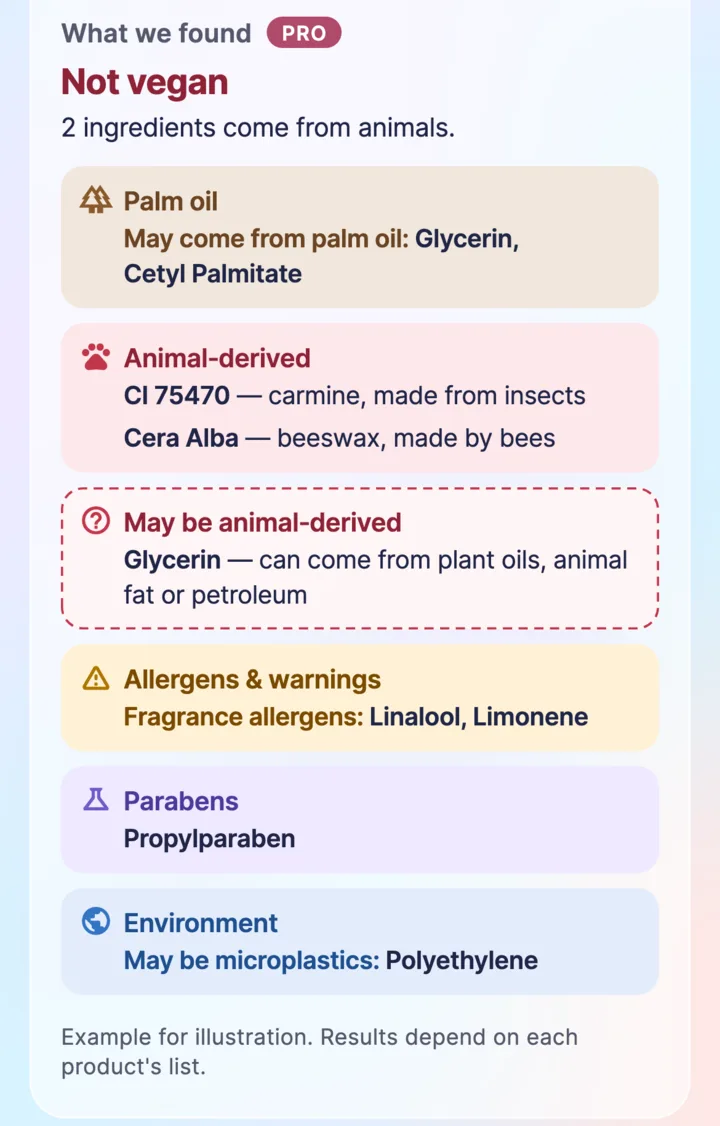
Example: tinted lip balm (fictional)
What we found
Not vegan
Contains carmine (made from insects) and 1 more animal-derived ingredient. 2 ingredients come from animals.
Animal-derived
- CI 75470 — carmine, made from insects
- Cera Alba — beeswax, made by bees
May be animal-derived
- Glycerin — can come from plant oils, animal fat or petroleum
The label doesn't say which source.
Allergens & warnings
Fragrance allergens: Linalool, Limonene
Relevant if you have a fragrance allergy. Sources: Regulation (EC) No 1223/2009, Annex III; Regulation (EU) 2023/1545
Palm oil
May come from palm oil: Glycerin, Cetyl Palmitate
Often made from palm oil. The label doesn't say. Source: EU CosIng database
Environment
May be microplastics: Polyethylene
Depends on its form, which the label doesn't show. Sources: Regulation (EU) 2023/2055; Beat the Microbead
Ingredients (10)
- Ricinus Communis Seed Oilskin conditioning, perfuming
- CI 75470colorantAnimal-derived: carmine
- Cera Albaemollient, emulsifying, film formingAnimal-derived: beeswax
- Glycerinhumectant, skin protecting, solventMay be animal-derivedMay come from palm oil
- Cetyl PalmitateemollientMay come from palm oil
- Polyethyleneabrasive, film forming, viscosity controllingMay be microplastics
- Linalooldeodorant, perfumingFragrance allergen
- Limonenedeodorant, solvent, perfumingFragrance allergen
- PropylparabenpreservativeParaben
- Tocopherolantioxidant, skin conditioning
What each ingredient does: EU CosIng (CC BY 4.0).
Example for illustration. Results depend on each product's list.
How sure is the result?
The vegan part of the result has one of four levels. The label alone decides it.
- Not vegan
- The list includes an ingredient that comes from animals, for example carmine (CI 75470), which is made from insects.
- Possibly not vegan
- Some ingredients, such as glycerin, can come from animals or other sources. The label doesn't say which; only the maker knows.
- Couldn't check every ingredient
- The app couldn't recognize enough of the list, or the list looks cut off, so it doesn't give an answer.
- No animal-derived ingredients found
- None of the ingredients it recognized is on its list of animal-derived ingredients, and the result says how many it recognized. This isn't a certification: the app can't see how suppliers make each ingredient.
Facts, not ratings
"What we found" lists facts with a source, for example that an ingredient is a labeled fragrance allergen in the EU, or a silicone. In the app, each fact sheet says: "This is a fact about the ingredient, not a rating of the product."
A fact about an ingredient (a hazard) is not the same as a risk from this product. Risk depends on how much is used and how you use it, which a label can't tell us. So Bunny Search doesn't score products or rate them as good or bad for you.
Apps such as Yuka and Think Dirty rate products; Bunny Search doesn't. If you want a health rating, those apps answer that question. See how the apps compare.
What's free, what's Pro
| Feature | Free | Bunny Search Pro |
|---|---|---|
| Brand checks: search, barcode → brand, type the brand, web A–Z directory | Always free | Included |
| A product's ingredient list (from its barcode) | Included | Included |
| Ingredient Check: animal-derived (and "possibly"), EU fragrance allergens, parabens, palm oil, microplastics, more details | A few free checks | On every product you check; automatic when we have the list (fair use applies) |
| Photograph the ingredient list (AI reads it) | Uses one free check, only if the read works | Included |
| Photograph a logo to find the brand | A few free logo photos | Included |
| History (on this phone) | Included | Included |
| Products you've checked | Stay viewable | Stay viewable, even if you cancel |
Bunny Search Pro is a monthly or yearly subscription; the app shows the current price. Cancel anytime in your App Store or Google Play settings. Your subscription keeps brand checks free for everyone. Pro is ad-free, guaranteed.
The free app has no ads either.
Your photos
- The app asks before your first photo is sent. You can withdraw consent in Settings › "Photos to AI", and the app asks again before the next photo.
- A third-party AI service reads the text from the photo. It doesn't decide anything: fixed rules do the checking.
- Photos aren't kept. Only the list read from them is.
- A list is shown to others once two people's photos agree. One person can't publish a list alone, and nothing that identifies you is shown. A list photographed without a barcode stays private.
- To have your data deleted, copy your user ID in Settings and email it to support@bunnysearch.app.
Who reads the photos and where they're processed is in the privacy policy.
Tips for a good photo
- "Take 1–3 photos of the list only. It's usually on the back, near the barcode."
- Look for a list that starts with "Ingredients" or "INCI". It can be in small print on the bottom, under a peel-off label or on the outer box.
- "Wraps around the bottle? Rotate it and add another photo".
- Hold the phone steady, fill the frame with the list and avoid glare.
- If the list is printed in several languages, the app reads the INCI version, which uses the standard international ingredient names.
- If a photo can't be read, or isn't an ingredient list, the app tells you and the photo doesn't use a check.
What it can't do
- It's for cosmetics and personal care, not food or pet products.
- The AI can misread a photo, and databases have mistakes. The pack in your hand is always the final word. If something looks wrong, tap "Report an error".
- Whether a "may be" ingredient comes from animals depends on the supplier, and the label doesn't say.
- It doesn't consider how much of an ingredient is in the product.
- Formulas change. Different on your pack? Photograph it.
- The ingredient list doesn't tell you about animal testing. Check the brand for that; brand checks are free.
- Its product database is smaller than the big rating apps', so you'll sometimes photograph a label yourself.
- The app is in English.
Not medical advice. With allergies, always read the physical label.
A vegan scanner for cosmetics, not food
Bunny Search's vegan scanner checks makeup, skincare, hair care, body care and other personal-care products, such as sunscreen and toothpaste. Scan a food or pet product and the app says "This looks like a food or pet product". For groceries, use a food scanner.
It looks for the animal-derived ingredients that show up in cosmetics under unfamiliar names: carmine as CI 75470, beeswax as Cera Alba, lanolin, collagen, keratin, silk, snail secretion and more. It never shows a "vegan" badge. The most it says is "No animal-derived ingredients found", which isn't a certification.
Vegan isn't the same as cruelty-free. To see whether a brand tests on animals, check the brand, which is free in the app and in the brand directory. When you check a product from a brand's page and PETA or Ethical Elephant lists that brand as vegan, the app says so under the result if the label names ingredients that are or may be animal-derived. That never changes what was found on the label.
Questions
What does the Bunny Search ingredient scanner check?
It checks a cosmetic or personal-care product's ingredient list for animal-derived ingredients (100+, such as carmine, beeswax and lanolin) and for ones that may be animal-derived (such as glycerin). It also flags EU-listed fragrance allergens and ingredients banned in EU cosmetics, parabens, palm oil (made from or may come from), possible microplastics, and more details such as silicones and sulfates. Each fact comes with its source.
What does "Possibly not vegan" mean?
The list includes an ingredient that can come from animals or from other sources, such as glycerin or stearic acid. The label doesn't say which; only the maker knows. If it matters to you, ask the brand.
Is "No animal-derived ingredients found" a vegan certification?
No. It means none of the ingredients the app recognized is on its list of animal-derived ingredients, and the result says how many it recognized. The app can't see how suppliers make each ingredient, so it never shows a "vegan" badge.
What if the product has no barcode, or its ingredient list isn't on file?
Photograph the ingredient list: take 1–3 photos of the list itself. A third-party AI service reads the text, and fixed rules check each ingredient. A free check is used only if the read works.
What happens to my photos?
The app asks before your first photo is sent. A third-party AI service reads the text; it never decides the answer. Photos aren't kept, only the list read from them. A list is shown to other people once two people's photos agree, and a list photographed without a barcode stays private. You can withdraw consent in Settings › Photos to AI. The privacy policy has the details.
Can I try the Ingredient Check for free?
Yes, with a few free checks. After that, the Ingredient Check is part of Bunny Search Pro, a monthly or yearly subscription; the app shows the current price. Brand checks and a product's ingredient list stay free.
Is it the same as Yuka or Think Dirty?
No. Apps such as Yuka and Think Dirty rate products; Bunny Search doesn't. It states facts about each ingredient, with sources, and answers a different question: does this product contain animal-derived ingredients? It also shows what 10 cruelty-free and vegan lists from 9 organizations say about the brand.
Is the ingredient scanner on Android?
Yes. The Ingredient Check is in the Bunny Search app on iPhone and Android. Brand checks are free on both, and in the web brand directory.
More questions about brands, lists and the app: see the FAQ and how it works.
Check what's in your next product
Bunny Search is on iPhone and Android. Brand checks are free on both.
Free download · Brand checks free · Try the Ingredient Check for free
After the short setup, tap 'What's in this product?' on Home.
Not medical advice. With allergies, always read the physical label.
Ingredient names and functions: European Commission CosIng database, © European Union, CC BY 4.0. Retrieved 2026-09-28. Functions lower-cased and abridged.
Contains information from Open Beauty Facts, available under the ODbL.
Some ingredient lists: data provided by the U.S. Food and Drug Administration (openFDA).
